John Leandro
The TommyknockersJohn Leandro is a Bangor journalist whose conviction that something extraordinary is happening in Haven turns scattered local anomalies into an investigation. Initially mocked as “Crazy Johnny,” he persists: the story he seeks may be dangerous, but he is unwilling to leave it unexplored.
Identity and Background
Leandro is a reporter preparing to travel from Bangor to Haven in search of a major story. He is also closely involved in his religious community: on Sundays he teaches young children, attends worship, and joins a Young Men for Christ meeting. The combination leaves him feeling both uplifted and tired, and helps explain why his trip is delayed even after his vacation begins.
His home life also shapes his schedule. He lives with his widowed mother, who hopes he will drive her to Nova Scotia to visit her sister. Rather than immediately setting out for Haven, Leandro takes her on the trip and stays overnight. His pursuit of a scoop therefore begins amid familiar family and community obligations, not as a clean break from ordinary life.
The Story He Pursues
Leandro has already faced mockery from David Bright, who compares him to Jimmy Olsen and makes jokes about his supposed special wristwatch. The ridicule hurts, but Leandro does not take it as evidence that his suspicions are wrong. He believes that Bright and the others who have heard his ideas will eventually recognize that Haven contains a real story.
His intuition is expressed as a recurring sense that something large is underway. Leandro feels it with unusual certainty, at times imagining that he can almost smell it when the wind comes from the southeast. The impression is not yet an explanation; it is the starting point that makes him treat otherwise disconnected incidents as clues.
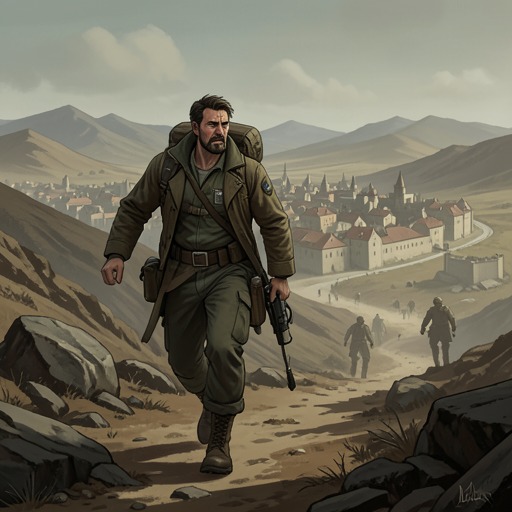
By Monday, August 15, Leandro is ready to leave for Haven. He packs yellow legal pads, a Sony tape recorder, a Nikon camera, and a bag containing film and lenses into his used Dodge. He understands the trip as a chance at journalistic glory, though he has no idea that he is approaching the center of an event that will become an immense story. His determination is captured in his decision to investigate rather than retreat: what he has encountered seems too substantial to ignore.
Evidence and Investigative Method
On the road near Derry, Leandro stops not far from the place where a gutted deer and the police cruiser assigned to Benton Rhodes and Peter Gabbons were found. He checks the glove compartment for a Smith & Wesson .38 he bought in Bangor the previous week. The gun is unloaded, and he keeps his finger away from the trigger. Its weight and compactness give him a sense of power, but also make him uneasy, as if he has taken on more than he can manage. He drives on, aware that he is more nervous than the warm day alone would explain.
Leandro’s suspicions rest on a growing list of reports. The death of Ruth McCausland has been attributed to a furnace explosion; two state troopers investigating the matter have disappeared; and a police officer said to have loved her has died by suicide. Earlier, David Brown disappeared. Leandro has also heard that David’s grandfather, Ev Hillman, had been talking about telepathy and magic tricks that really worked. Leandro wishes Hillman had come to him rather than to Bright, but Hillman too has vanished from view.
The official position that Hillman has not disappeared does not satisfy Leandro. The state-police explanation turns on the legal requirement that one adult report another missing, leaving the old man’s absence formally unrecognized. Leandro checks the circumstances for himself: Hillman has not returned to his rooming house for more than two weeks, has not visited his grandson at Derry Home Hospital, and has left an unpaid sixty-dollar bill with his landlady. As far as Leandro can discover, that is the first bill Hillman has failed to pay.
Other irregularities broaden the case beyond individual disappearances. A July fire killed a couple on Nista Road. In August, a doctor’s small plane crashed in Newport after flying over Haven at an illegally low altitude. Phone service in Haven has become unreliable, with some calls going through and others failing. Leandro obtains a list of Haven voters from the Augusta Bureau of Taxation for six dollars, then traces relatives of nearly sixty residents in Bangor, Derry, and nearby places. He finds no one who has seen a Haven relative since around July 10, more than a month earlier. Some relatives are estranged or initially unconcerned; others become thoughtful when he points out how long the absence has lasted. Many assume summer has simply passed quickly and remember speaking to relatives on the phone, even if the calls have not always connected.
Resolve and Narrative Role
The investigation develops through the contrast between Leandro’s pattern-making and the explanations that make each incident seem ordinary in isolation. A furnace explosion, a plane crash, a missing child, absent troopers, a failed phone call, and an unpaid bill belong to different categories of news; Leandro’s work brings them into one accumulating case. His reporting tools—the legal pads, recorder, camera, and lenses—make that effort practical, while his growing unease marks the limits of what he can yet explain.
The material establishes Leandro as a persistent investigator rather than a detached observer. David Bright’s jokes wound him, and the gun unsettles him, but neither reaction ends his effort. He continues toward Haven because the evidence, however incomplete, has become harder for him to dismiss than the ridicule surrounding it. His arrival at the edge of the town’s crisis is framed as both professional ambition and an irreversible commitment to find out what is happening.